
Conference Hall Acoustics
Conference Hall Acoustic Engineering & Project Design
Conference hall acoustics are paramount to delivering successful events, keynote addresses, and international symposiums. Achieving pristine speech intelligibility and precise reverberation control relies entirely on rigorous acoustic design. Architects, interior designers, and acoustic consultants prioritize high-performance acoustic modeling during the project design phase to maximize sonic clarity across the entire auditorium.
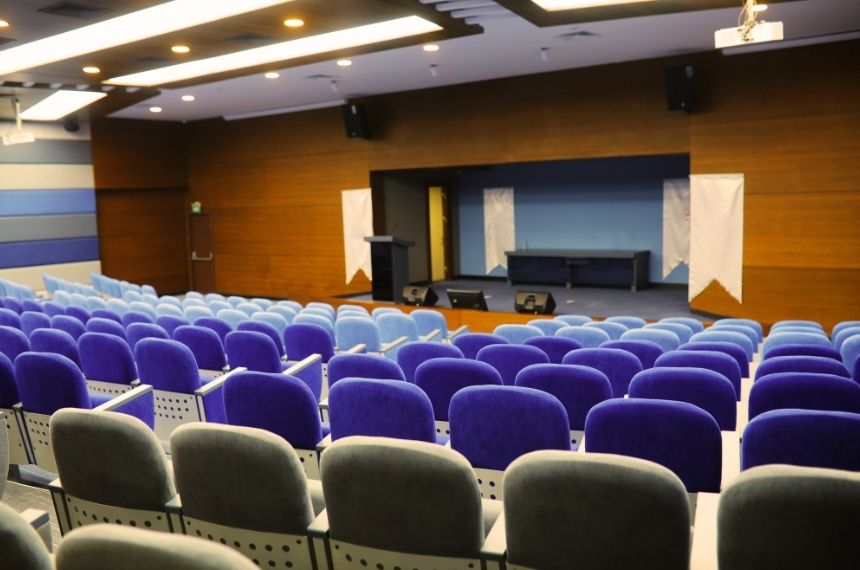

Conference Hall Architecture & Spatial Design
Auditorium and conference hall architecture must balance functional aesthetics with acoustic performance to provide an optimal audiovisual experience. Structural ceiling height, wall splay angles, and the overall room geometry dictate how sound waves propagate throughout the hall:
Reflective & Diffusive Geometry: Strategic wall angling and ceiling reflectors direct early sound energy toward the rear seating rows.
Sightlines & Seating Layout: Raked (tiered) seating configurations preserve clear sightlines while reducing sound attenuation caused by the audience plane (grazing incidence).
Uniform Sound Coverage: Balanced architectural acoustics eliminate acoustic shadows, flutter echoes, and dead zones, delivering even sound pressure levels to every seat.
Precise Acoustic Engineering for Auditoriums & Halls
Professional acoustic engineering requires bespoke solutions tailored to the physical dimensions and volume of the hall. Utilizing advanced 3D digital ray-tracing and acoustic simulation software, acoustic engineers map sound propagation, calculate Reverberation Time (RT60), and optimize the Speech Transmission Index (STI) before construction begins.
This predictive analysis factors in audience capacity, HVAC noise criteria (NC/RC curves), and the placement of line-array audio reinforcement systems to guarantee balanced, articulate sound for every attendee.
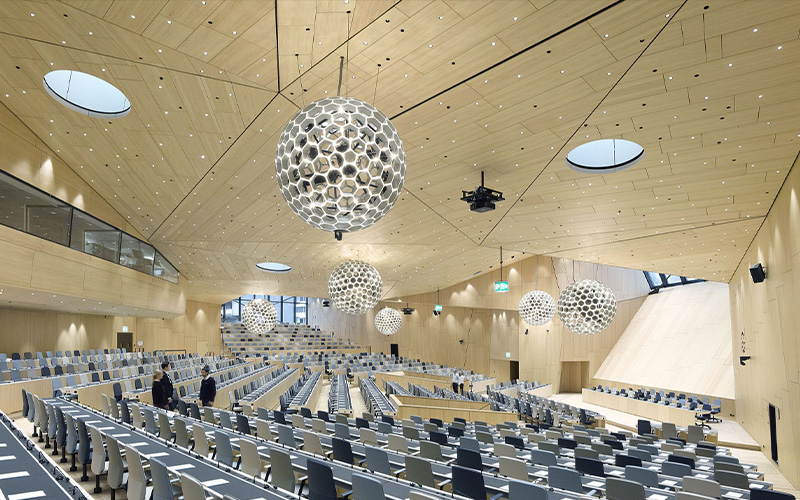
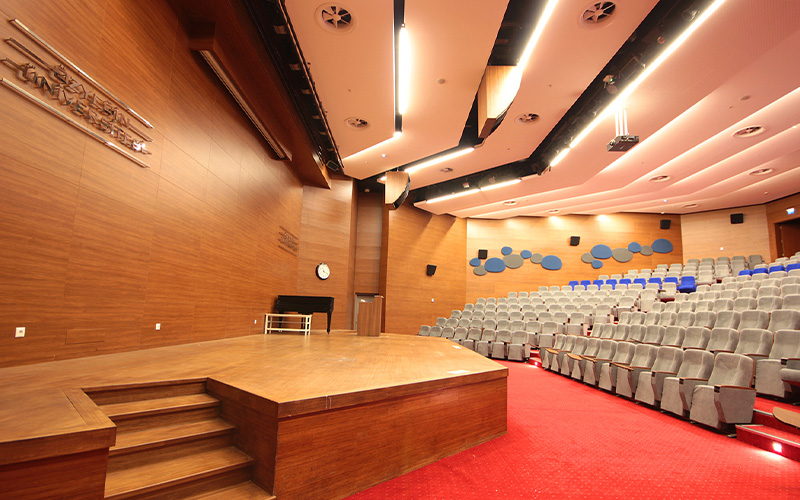
Acoustic Consulting & Project Planning
The Vital Role of Acoustic Materials in Auditorium Projects
Overcoming common auditorium issues such as excessive reverberation, ambient HVAC rumble, and acoustic bleed requires high-performance acoustic materials:
Fabric-Wrapped Wall Panels: Absorb mid-to-high frequency vocal reflections along peripheral walls to eliminate flutter echo.
Suspended Acoustic Ceiling Clouds & Baffles: Control vertical sound decay and prevent ceiling-to-floor standing waves.
Diffuser Panels (QRD / Wooden Diffusers): Scatter specular reflections to maintain acoustic energy without making the hall feel unnaturally dead.
Soundproof Wall Assemblies & Acoustic Doors: High-STC composite partitions and acoustic seals block exterior noise intrusion, preserving indoor signal-to-noise ratio.
Acoustic Impact of Conference Seating Design
Auditorium and conference seating influences acoustic response far beyond ergonomic comfort. Seating constitutes a major percentage of the total absorption surface in a hall:
Equivalent Acoustic Absorption: Seats must be engineered with acoustically tested upholstery fabrics and open-cell foam cores that mimic the sound absorption coefficient of an occupied chair.
Occupancy Invariance: Calibrated acoustic seating ensures the hall’s reverberation time remains consistent whether the venue is completely full, half-occupied, or empty during rehearsals.
Under-Seat Ventilation Integration: Perforated acoustic seat pans can be combined with displacement ventilation systems to reduce mechanical airflow noise.
Selecting High-Performance Acoustic Insulation Materials
Acoustic insulation materials specified for public assembly halls must deliver technical acoustic performance alongside strict architectural safety compliance:
Core Absorption Media: High-density rock wool, glass mineral wool, and acoustic foams provide broadband absorption coefficients across target frequency bands.
Fire Safety Compliance: Materials must meet international flame-retardant standards (e.g., Class A / EN 13501-1 Class B-s1, d0) for commercial interiors.
Architectural Integration: Perforated wood acoustic panels, micro-perforated acoustic fabrics, and modular acoustic ceilings integrate cleanly into high-end architectural schemes.
Elevating the acoustic quality of large conference halls depends on strategic material selection, precision acoustic simulation, and seamless interior architecture. Synchronizing these disciplines creates a quiet, articulate, and acoustically balanced environment for every presentation.